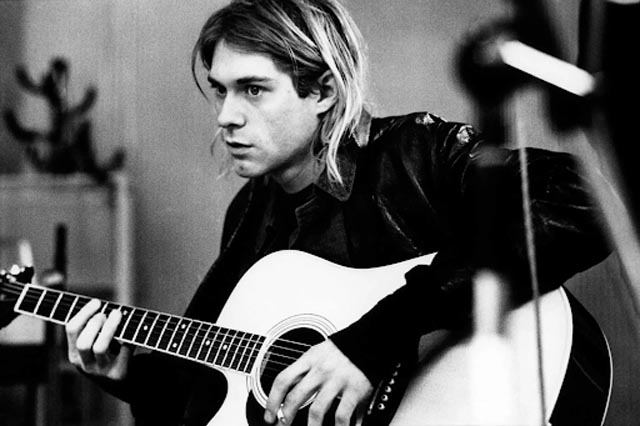
Somewhere between a true crime subreddit and a flannel-scented fever dream lives Michelle Wilkins. She is, depending on who you ask, either a meticulous civilian researcher or the protagonist in a story that says more about America’s relationship with dead rock stars than it does about ballistics. Wilkins leads an independent, unofficial forensics team—unofficial in the way garage bands are unofficial before they accidentally change culture—that compiled a 200-page binder and a thumb drive and handed both to the Seattle Police Department after reexamining the publicly available evidence in the Kurt Cobain case (read my editorial here).
What happened next felt preordained in the modern way things do: an article in the Daily Mail, a digital brushfire, and the sudden realization that the 1990s are not done with us yet. The Cobain narrative—grunge messiah, tragic inevitability, cultural punctuation mark—has always hovered somewhere between fact pattern and folklore. Wilkins decided to treat it like a math problem. This week, I sat down with her for a long, occasionally disorienting conversation about theories, forensic methodology, jurisdictional gray zones, media amplification, and the strange permanence of the’ 90s—an era that refuses to stay archived. If the past is a closed case, Michelle Wilkins is politely asking to see the file again.
Michelle, before this became a forensic crusade, it was just a moment in time. How old were you when Kurt Cobain died, and who were you culturally? Were you the kind of person who absorbed tragedy as biography or as mythology? What did the air feel like back then—was it grief, or was it the sudden understanding that fame had an expiration date?
I was eighteen and living in Alberta when Kurt died, and I was just becoming a pop punk kid — the kind of kid Nirvana accidentally creates without meaning to. They were my gateway band. They made the world suddenly feel bigger, messier, andmore possible. I didn’t even know what scene I belonged to yet; I just knew that sound felt like home. It pushed me toward pop-punk, toward finding my people, and eventually toward starting my own band because nothing around me looked like the music that lived in my head.
So when Kurt died, it didn’t hit me as a neat biography or mythology. It felt more like the floor dropped out of the culture for a second. Not quite grief, because I didn’t know him — but a shock that someone who’d cracked open that part of me could just be gone. And at that age, I assumed the adults would get the truth right. I didn’t question the investigation. I didn’t think I had to. It took nearly three decades — and finally,looking at the real evidence — to realize the story had been sealed before anyone truly examined the details.
When you started reexamining Cobain’s death, were you trying to solve a crime—or were you trying to reopen a story that culture had already laminated and hung on the wall sometime around 1995?
When I started reexamining Kurt’s death, I wasn’t hunting for a crime at all. I was looking at it through an adult lens, trying to make sense of the emotional reality behind the headlines. I’d learned about the domestic abuse he was experiencing — abuse toward him — and my first thought was, honestly, did he reach a breaking point? Could that level of fear, exhaustion, and psychological pressure have pushed him to take his own life?
That was my starting point: compassion and context, not suspicion. But when I finally sat down with the actual evidence — the forensic documentation the public never really sees — the emotional theory didn’t match the physical facts. And once that happens, you stop thinking in terms of cultural mythology and start asking very simple, practical questions. So no, I wasn’t trying to resurrect a story from 1995. I was trying to understand a human being. The investigation only reopened itself once the evidence demanded it.
Do you think people are magnetized to the idea of homicide because suicide feels narratively too coherent? Like the ending lines up so cleanly with the lyrics that it starts to feel suspicious— almost as if the symbolism is doing too much work?
I think a lot of people are drawn to the idea of Kurt as this almost mythic ‘wounded healer’ figure — the artist who bleeds so the rest of us can feel understood. That archetype is powerful. It makes people want a story that matches the tragedy they projected onto him: the hurting kid who couldn’t carry the weight anymore. But that’s mythology. It’s not evidence. And honestly, I’m not drawn to that narrative at all. Not because I don’t understand it — I do — but because it flattens him. It turns a real human being into a symbol that conveniently explains everything. When you make someone an archetype, you stop looking at the details of their actual life, their relationships, their fear, their agency, their contradictions.
I’m interested in Kurt as a person, not as an omen or a lesson. I don’t need him to fit the ‘wounded healer’ script to make sense of his art or his impact. What I’m looking. Now is the physical reality of how he died. And that requires stripping away myth, not leaning into it. A story can feel emotionally right and still be factually wrong. My work is about separating those two things — even when the mythology is seductive.
In the interview you did with Matt Beall (I know you’ve been on a few times), you mentioned the mishandling of evidence by authorities as rumored (which we all know rumors are just anonymous truths); what are the chances that the original evidence has been tampered with? Do you think someone could have messed with the crime scene before the pictures were taken?
I like the way you put that. Here’s the thing: people throw around ‘mishandling’ and ‘tampering’ like they’re the same thing, and they’re not. When I talk about rumored mishandling, I’m not spinning conspiracy — I’m pointing out that the 1990s were not exactly the golden age of airtight forensic protocol, especially in cases where a bully-cop like Don Cameron walks into a scene and declares it a suicide before even waiting for the medical examiner to show up. Now, does that mean someone sneaked into the room, twirling a mustache and rearranging the evidence? No. Does it mean the scene was handled in a way that leaves a lot of valid questions? Absolutely.
Real crime scenes are messy. You’ve got first responders, medics, detectives, photographers — and they don’t arrive in this neat little ballet sequence people imagine from TV. Things get moved for access. Things get touched because someone didn’t realize they shouldn’t. And if those movements weren’t documented — which, in this case, some weren’t — that creates interpretive landmines decades later.
When you’re trying to reconstruct what happened 30 years later, those little gaps matter. They don’t automatically prove anything sinister — but they absolutely mean we can’t treat every photo or item as if it dropped from the sky fully formed. The question isn’t ‘Who tampered?‘ It’s: ‘What exactly happened before the shutter clicked, and why wasn’t it recorded?‘That’s not a conspiracy. That’s just forensic reality with a grunge soundtrack.
How did you and Bryan Burnett become co-conspirators in this intellectual excavation? What’s the origin story? Was it a casual conversation that escalated, or did it feel inevitable? How many hours of your life now exist exclusively because of April 1994? And if you had to define the one missing piece that would make you both exhale, what would it be?
The origin story wasn’t cosmic — it was strategic. I sought out Bryan Burnett because of his surgical, no-nonsense work on the James Sabow case. He was the kind of forensic mind you call when the evidence is weird, the documentation is inconsistent, and the truth has been sitting under thirty years of cultural dust. Once he agreed to take a look, my small research team and I shifted into full reconstruction mode. If Bryan needed something, we got it — SPD reports, photo sets, obscure documents, timelines. We secured a full handwriting analysis. We connected him directly with our ballistics expert so nothing got watered down or filtered through interpretation.
This wasn’t two researchers casually comparing notes. It was a tiny, highly focused investigative unit assembling a case file that had never actually existed in one place before — and handing it to a forensic analyst who wasn’t afraid to dig. How many hours of my life exist because of April 1994? Enough to qualify as a parallel life. Entire seasons of work, research, travel, and emotional investment — all orbiting a single weekend in Seattle that still hasn’t been properly reckoned with. And the one missing piece that would finally let all of us exhale? Transparency.
Not a dramatic twist — just the full, unfiltered investigative record: internal memos, uncirculated photos, lab notes, chain-of-custody clarifications. All the quiet, bureaucratic details that tell you what really happened before the mythology set in. People think old cases hinge on bombshells. They don’t. They hinge on the paperwork no one ever bothered to line up — until now.
On your Substack, Lisa Francy writes about the backlash—about the sense that you were trespassing on territory already declared settled. What does it actually feel like to be told you’re crossing lines that may or may not be real? At what point does resistance become proof of friction, and at what point does it become evidence that you’re simply unwelcome?
Being told I’m trespassing on “settled territory“ is funny, because the only thing settled about this case is the complacency around it. Those lines people accuse me of crossing? They’re chalk outlines someone drew in 1994 and hoped no one would notice were crooked.
But here’s the truth people don’t see: the worst backlash hasn’t come from institutions — it’s come from self-appointed “gatekeepers” who’ve spent years pretending to work for Kurt while doing absolutely nothing to uncover what actually happened to him. The moment real progress started, they didn’t debate the evidence. They didn’t engage. They went straight to harassment, doxxing, coordinated abuse, and outright lies.
All because someone new showed up willing to do the work they never had the courage, discipline, or integrity to do themselves. This wasn’t just criticism. It was a campaign — months of being stalked online, threatened, smeared, impersonated, reported, sabotaged, and screamed at by people who claim to “protect Kurt’s legacy“ but have no interest in truth. They weren’t trying to guard him. They were trying to guard their egos. And the idea that anyone else’s name might be associated with Cobain — especially someone actually producing evidence — sent them into full meltdown.
At first, resistance looks like friction. But when the resistance becomes, “You’re not allowed to look here,“ or “Stop investigating or we’ll ruin your life,” that’s not friction. That’s fear. And fear is the best map a forensic investigator can have. Every time someone tells me I’m crossing a line, what I actually hear is: You’re getting close. If those boundaries were real, they wouldn’t need to bully me into respecting them. They wouldn’t weaponize mobs to silence me. They wouldn’t implode the second someone starts asking hard questions. So keep telling me what I can’t do.I’ll keep doing it — with better evidence, better experts, and more persistence than any hate campaign can handle.
Cobain existed inside a very specific heroin culture—one that was both romanticized and catastrophic. Do you think that culture has evolved, or just rebranded itself? And if someone reading this is struggling with heroin right now, what does this case teach them that a cautionary after-school special never could?
To start, I am going to quote Lisa Francy, who works in recovery: “If Kurt’s case taught us anything, it’s that addiction can touch anyone. It doesn’t care about your job, your fame, or your bank account — it cuts across every line. Kurt never wanted kids to use drugs because of him, and he didn’t want to be trapped in it himself. Addiction is a daily fight to stay alive, and in today’s world, that battle has only gotten more dangerous with drugs being cut to make them cheaper and far more potent.“
Kurt Cobain came out of a very specific heroin culture — one that looked edgy and poetic on the surface, but underneath was completely catastrophic. People romanticized the aesthetic, the danger, the ‘tortured artist‘ mythology, but the reality was organ damage, respiratory collapse, infections, and a drug supply that was already unpredictable even in the 90s.
Has that culture evolved? Honestly, it hasn’t evolved — it’s rebranded. The music is different, the slang is different, the packaging is different, but the physiology hasn’t changed. The drug supply is now more volatile, more contaminated, and less forgiving. What used to be a ‘scene‘ is now a medical emergency that doesn’t care about anyone’s mythology.
And if someone reading this is struggling with heroin right now, here’s what this case teaches you in a way an after-school special never could: You deserve a life that isn’t a battle with your own chemistry. Heroin turns every day into survival mode. There’s no creativity, no romance, no rebellion in that. It steals the future in tiny increments long before it takes the final blow. Getting help isn’t a weakness — it’s a strategy.The bravest thing anyone in that culture can do isn’t endure it. It’s stepping out of the story before it writes your ending for you. You are allowed to live long enough to become someone you haven’t met yet.
If there’s a single piece of evidence that would send your homicide theory into hyperdrive, what is it? And what do you imagine might still exist in the files of the Seattle Police Department—not as conspiracy, but as bureaucracy?
If there were one piece of evidence that would send the homicide theory into hyperdrive, it wouldn’t be a dramatic reveal — it would be a witness statement. A credible, contemporaneous account from someone who was present in the days or hours around the death of Kurt Cobain and was never interviewed by police.
And the reality is: We know those people exist. There were numerous individuals in and around the property when Kurt died, and the Seattle Police Department never spoke to them. Not then, not later, not even during the 2014 “review.” That’s not speculation — that’s a matter of record. A single, properly documented witness statement — especially one noting unusual activity, additional people at the house, timeline contradictions, or anything inconsistent with the official narrative — would immediately force a re-evaluation of the case. Not because it ‘proves‘ homicide, but because it fills one of the most glaring procedural voids in the investigation.
You were recently back on Matt Beall’s podcast, revisiting November of last year—the moment this investigation went from niche obsession to public spectacle. Did that month feel like vindication, escalation, or the exact second you realized this would never again be a private intellectual exercise?
When I went back on Matt Beall’s podcast last week, and we revisited November, I realized people often think that was the moment everything changed. And in a way, it was — but not because the world was watching.
November was when our small team actually sat down inside the Seattle Police Department. It felt like the culmination of two years of work that we had done quietly, obsessively, carefully. Sitting in that room, presenting what we’d found, I remember thinking, ‘They’re finally seeing this. They’re hearing it. No matter what happens next, the truth is at least on the table.‘
For a brief moment, I let myself believe that being thorough, being respectful, andbeing evidence-based would be enough. That the work would speak for itself. That someone — anyone — in authority would pick up the thread. And then I had no idea how quickly it would all be dismissed. That part hurt more than I expected. Not because I needed validation, but because it showed me how fragile truth is inside a system that has already made up its mind.
But the moment this stopped being a private intellectual exercise wasn’t November. It was the day the Daily Mail article came out. Suddenly, the research that had lived in my notebooks and late-night calls with experts was out in the open. People I’d never met had opinions about it. Journalists were calling. Producers were calling. Doctors were reaching out. And I realized:
‘This isn’t mine alone anymore. This is public now. This carries weight.‘So yes — November was the quiet turning point. A moment of hope, even if it didn’t last. The Daily Mail was the irreversible one — the moment I understood that the work had stepped into the world, with or without permission, and that I had a responsibility to carry it with as much integrity as I could.
If Cobain had been an insurance adjuster in Tacoma instead of the frontman of Nirvana, would anyone in 2026 be debating handwriting samples and shotgun angles? Or is this really about our collective inability to let cultural icons die in ways that feel ordinary?
If Kurt had been an insurance adjuster in Tacoma instead of the frontman of Nirvana, no one in 2026 would be debating handwriting samples or shotgun angles. His case would’ve been stamped, filed, and forgotten by lunchtime.
But here’s the part people don’t like to admit: Celebrities aren’t the only ones who deserve real investigations — they’re just the only ones whose cases get enough public attention to expose the failures.
So yes, culturally, we’re terrible at letting icons die in plain, unpoetic ways. We want their endings to rhyme with their lyrics. We want a mythology, not a medical chart. In that sense, Kurt was never going to be allowed an ‘ordinary‘ death — not by fans, not by the media, and honestly, not by the narrative machine that loves a tragic rock star. But the rebellious truth is this:
Fame didn’t create the inconsistencies — it just made them visible. Because if this exact evidence pattern belonged to a random guy in Tacoma, nobody would question it… But that’s not a compliment. That’s the problem. The process should be airtight, whether the deceased was a rock legend or a guy behind a cubicle. Instead, what happened was the opposite:
The myth of the doomed artist made the investigation lazier, not sharper. It gave everyone permission to say, ‘Well, of course he died, he was Kurt Cobain.‘ That’s not closure. That’s narrative convenience disguised as certainty. So is this about our inability to let cultural icons die ordinary deaths? Partly. But it’s also about our inability to admit that an extraordinary life shouldn’t excuse an incomplete investigation. Kurt wasn’t too iconic to die an ordinary death. He was just iconic enough for investigators to assume he was another wasted rock star — and not look closely when the evidence didn’t match.
When law enforcement says “the case is closed,“ do you hear confidence? Fatigue? Or the quiet institutional reflex of self-preservation?
When I hear law enforcement say, ‘the case is closed,‘ it doesn’t sound like confidence — it sounds like convenience. It’s the institutional version of, ‘We’re tired, stop asking.‘And beneath that? Self-preservation. Always. Declaring a case closed is easy. Reopening it means paperwork, scrutiny, and the possibility that someone has to admit a mistake. Institutions don’t love that plot twist. So when they say the case is closed, what I actually hear is: ‘We made our call in 1994, and we’d prefer not to revisit whether it was the right one.’
What’s the functional difference between an independent research team and a fan community with exceptional document management skills? The functional difference?
A fan community can collect every scrap of paper ever written about a case — sometimes better than the cops did — but an independent research team has to turn that mountain of chaos into something admissible, testable, and impossible to ignore. Fans accumulate receipts. Researchers weaponize them. A fan community can say, ‘Look what we found.‘
A research team has to say, ‘Here’s the source, here’s the timeline, here’s the corroboration, and here’s why it rewrites the conclusion.‘Fans can love the story. We have to dismantle it. So the difference is this: A fan community builds an archive. A research team builds a case.
There’s a hairline fracture between skepticism and suspicion. At what point did your work stop feeling like healthy doubt and start feeling like you were pushing against something structurally immovable?
Skepticism is a healthy place to start. For a long time, that’s all it was — me trying to understand a case without the static of 1994 wrapped around it. I wasn’t looking for villains. I wasn’t assuming anything was wrong. I was just following the evidence where it led.But there was a moment — and I can tell you exactly how it felt — when the work stopped being about curiosity and started being about resistance. Not my resistance… theirs.
Every time we found an inconsistency, I expected someone in authority to say, ‘Okay, let’s look at that.‘But instead, what came back was nothing. Or worse — the quiet, polite dismissal that tells you no one intends to lift a finger.And that’s where the fracture opened. Skepticism says, ‘Let me double-check the evidence.‘Suspicion whispers, ‘Why is everyone pretending not to see what’s right in front of them?‘
I didn’t become suspicious because I wanted to. I became suspicious because the institutions who should care… didn’t. Because the truth didn’t seem to matter as much as protecting a conclusion they cemented thirty years ago. It was wounding, honestly — realizing that even when you do everything right, even when the evidence is solid, an entire structure can look past you like you’re not even in the room. But defiance grew in the same place the hurt did. If the system won’t move, then I will. If they won’t ask the questions, then I’ll keep asking louder. The immovable wall didn’t stop me — it just clarified exactly where to push.
Reopening a case almost implies you believe the first answer might be wrong. How do you guard against confirmation bias when your starting premise is already an act of doubt?
People assume reopening a case means I already think the original answer was wrong.Not really — it just means I think the original answer deserved a fact-check. Confirmation bias only shows up when you’re trying to prove something. My entire method is trying to disprove everything — including my own instincts. I always start with the most boring, non-suspicious explanation possible. If it holds, great; if it crumbles, that’s not bias — that’s the evidence misbehaving.
Honestly, if I were trying to confirm a theory, this would all be a lot simpler. Instead, I’m wrestling with 30-year-old paperwork that contradicts itself more than my teenage diary. So how do I guard against bias? By assuming I might be wrong, and then watching the evidence refuse to line up neatly.Doubt wasn’t the conclusion. It was just the key that opened the door.
Do you ever worry that reframing Cobain’s death as potential homicide changes how people experience his music—that songs stop being songs and start becoming circumstantial evidence?
Honestly? People already treat his lyrics like a suicide note. Kurt would write a deliberately nonsensical line like ‘a mosquito, my libido,’ and somehow it’s still held up as psychological evidence. Almost every musician with a big back catalogue writes about dark themes. That’s not foreshadowing — that’s songwriting. And if you actually look at Kurt’s lyrics, he barely sings about suicide at all. People projected that onto the work retroactively because it made the official narrative feel neat.
So no, I don’t worry that considering homicide will make people overanalyze his songs. They’ve been overanalyzing them for thirty years. If anything, acknowledging the possibility of homicide liberates the music. It forces people to stop treating every metaphor or rhyme as encoded despair and lets the songs return to what they actually were: raw, playful, surreal, sarcastic, emotional, chaotic — sometimes meaningful, sometimes nonsense, sometimes both. Getting the manner of death right doesn’t turn the art into evidence. It takes the pressure off the art to explain a death it was never written to justify.
If the case were officially reconsidered tomorrow and reaffirmed as suicide, would that feel like closure? Or would it simply manufacture a new generation convinced that the “real truth“ is still hiding somewhere between celebrity, nostalgia, and the algorithm?
If the case were officially reconsidered tomorrow and they reaffirmed suicide, people love to imagine that would ‘settle‘ it. It wouldn’t. Not until the unanswered questions are actually answered, not papered over. And I want to be very clear: I’m not married to a homicide conclusion — I’m married to evidence. If they can show me real, scientific, replicable proof of suicide, then yes, I’d have to accept it. I don’t get to choose the truth just because I’ve spent years chasing it. But
That kind of proof would require a level of transparency and rigor we’ve never seen in this case. Right now, the record is full of contradictions, missing pieces, and interpretations that don’t match the physical evidence. You don’t get closure from that — you get resistance. So if they reaffirmed suicide without addressing the gaps, it wouldn’t calm anything. It would just manufacture a whole new generation convinced that the truth is still being buried somewhere between celebrity myth-making and institutional self-protection.
Closure only happens when the explanation is stronger than the doubt. And we’re nowhere near that. I really want to thank you for asking these questions. They matter. Not just because we’re trying to get Kurt’s manner of death corrected — though that’s a huge part of the work — but because I want people to finally see him. The real human being behind the noise, not the caricature that certain media narratives have recycled for 31 years to discourage anyone from looking deeper.
He wasn’t a headline. He wasn’t a trope. He was a person. And the more we approach him with curiosity instead of assumption, the more we create space for something he was rarely given: a fair chance at being understood, and a truth that doesn’t hide behind old narratives.
California progressive metalcore outfit Volumes closed 2025 with the release of their new album, Mirror Touch. Metal Insider recently caught up with vocalist Myke Terry to discuss the record, changes in the music industry, and more. Video Interview: Transcription:...
Writing about this is not easy. No one should feel comfortable confronting loss like this. At the Gates' video for their latest single, "The Fever Mask," goes far beyond the typical performance video format, cutting much deeper on an emotional level. Compiled by...
Australian-Finnish dark metal act The Eternal have unveiled a lyric video for the song, "Bleeding Into Light." The track is taken from their new EP, Celestial, which arrived last month via Reigning Phoenix Music. Vocalist and guitarist Mark Kelson comments: "The...
New & Noteworthy is Metal Insider’s weekly column highlighting some of the newest rock and metal releases coming out each week. This week includes new music from the likes of New Found Glory, Brian James, Exhumed, Yungblud and Sylosis amongst the many...
New & Noteworthy is Metal Insider’s weekly column highlighting some of the newest rock and metal releases coming out each week. This week sees new music from the likes of Converge, Gogol Bordello, Mariachi El Bronx and Story Of The Year amongst the many...
New & Noteworthy is Metal Insider’s weekly column highlighting some of the newest rock and metal releases coming out each week. The first New Music Friday of February sees LPs from the likes of Puscifer, KMFDM, Mayhem and Tailgunner amongst the many outstanding...