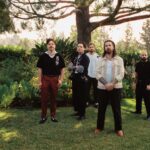
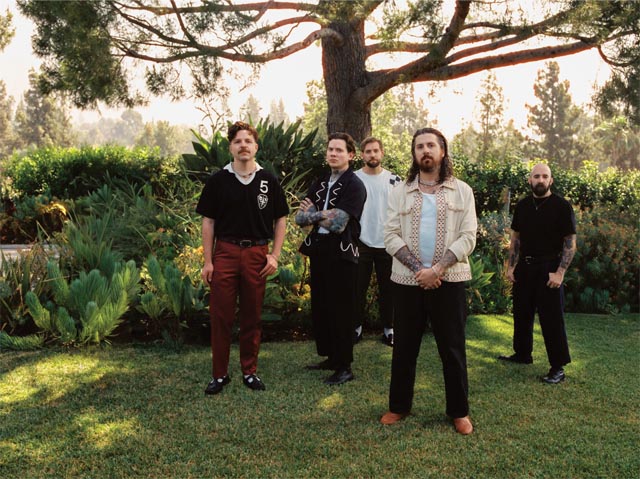
The Devil Wears Prada have never taken the easy route. Two decades into their career, the band continues to evolve while refusing to gloss over the harder parts of life. Their ninth studio album, Flowers (out November 14, 2025, via Solid State Records; read our review here), leans into grief, disillusionment, and spiritual unrest while still pushing boundaries. Before the band’s October 2025 Australian tour supporting Bullet For My Valentine, Metal Insider caught up with vocalist Mike Hranica to discuss the band’s latest effort, who Mike is inside and outside of the band, and more.
Video Interview:
Transcription:
How does it feel to be gearing up for Australia?
Oh, good. Good. You know, we haven’t been home that long, but it feels like it has been a while. It’s been a few weeks since we were in South America, so I’m checking the continents off the list this year.
Just going back to the origin and Identity. When you think back to 2006 and Dear Love: A Beautiful Discord, what do you actually remember feeling? Not what you think you should remember, but what your body felt like as you were recording that?
Is inexperience a feeling? Yeah, I never anticipated playing in a band for twenty years, sustainably. And here we are. And it would take me forever to describe whatever that feeling would be in 2006. I just wanted to write lyrics and go to shows, and if I played in a band, I wouldn’t have to buy a ticket. So that was the logic.
That’s the way it should be. Metalcore in the early 2000s had this weird purity, you know, the eyeliner and the breakdowns. They were like currency. But when you look back, how does it feel in 2025 to have outlived an entire subculture that you basically helped define?
It’s weird. I almost feel like an impostor at times because I knew how important the bands were to me, which defined metalcore back then. And, yeah, like, I want to say imposter because. I’m privileged enough to continue to do it, but to give myself a little bit of credit, I have had to work very, very hard for a long time. And, there’s certainly been downs as well as the ups, you know, times where I couldn’t make ends meet or times where you’re fighting with someone or you’re dealing with, you know, a personal relationship. So, I’m grateful to be able to do this for so long and to be afforded the opportunity.
What part of The Devil Wears Prada has remained the same since day one? And what part would teenage Mike absolutely hate about who you become?
For the first part, Jeremy [DePoyster] and I have always really tried to instill the idea that you work for The Devil Wears Prada. You don’t work for me. You don’t work for Jeremy. You don’t work for Jon [Gering]. It’s this orb, this idea, this project. That’s The Devil Wears Prada. And you serve that. And as you serve that, it’s all for the greater good of that thing. And getting to go along the ride is the privilege. And it’s what’s amazing. It’s what’s, you know, been my life for well over half of it. But when it gets to the knees, the eye, credit, or ego, that’s where it needs to, like, step aside.
Because The Devil Wears Prada again, isn’t it, Jeremy. It’s not me, it’s not Jon. It’s not Kyle [Sipress]. It’s not Giuseppe [Capolupo]. It is that orb, that thing. And I think we’ve always treated it that way. And we work very hard to treat it still that way to this day. The thing that young me wouldn’t like is that, I think, serving things at a time when I personally would want it a certain way, but for the greater good or for the sake of, like, popularity or success, it has to be a different way. A lot of people would define that as selling out. You could go on forever about what’s selling out, whether I’ve sold out, whether The Devil Wears Prada sold out. Honestly, it sounds like a boring conversation.
It sounds like jealousy. It’s high school jealousy, petty jealousy.
And that’s one of the bad things about early metalcore: it could be so competitive. Competitive, good, you know? But at the same time, like the gatekeeping, and the like, incestuous fighting was the bad side. It’s funny thinking back to like, the world tours and whatnot. And people were like, again, competing so much rather than helping open the door for the whole scene, you know? And that’s one of the better things going on now. But that’s a different topic.
I love that, though. It shows so much humor through the endurance of that era. You know, you’ve been through a lot. We’ve seen some stuff. Every Devil Wears Prada album seems to function like a time stamp for your inner life. How much of Flowers is autobiography versus, like, conceptual metaphor?
It’s deeply autobiographical. And not to speak for them, but especially for Jon and Jeremy, because for the longest time I formulated, like, every lyric The Devil Wears Prada made. And these days that’s not how it goes. Sometime during the act, really, Jon would just put lyrics to songs he worked on, and they were really good. And we started making songs like “Chemical,” which Jon wrote every lyric for. So, yeah, I again don’t want to speak too much for them, but it’s deeply autobiographical in terms of coming to terms with contentment, discontentment, anxiety, and stress. Yeah. I wouldn’t call it very conceptual in those regards.
The only argument I would have is with the video “Eyes.” That video made me feel like my space was like The Outlook Hotel. So I don’t know if you were going for those vibes, but they’re there.
I didn’t think of that.
That was a head trip. That whole video is a head trip. So the production of Flowers feels cinematic, almost like it’s breathing in between screams. Were you thinking in terms of film, photography, or visual storytelling while recording this?
Not so much for me. I think Jon and Jeremy were definitely kind of putting in the guidelines, or like projecting what the future was going to look like. I was trying to figure out what it was going to be called, first of all, but we did so much of this album without it being called Flowers.
And it’s kind of a point of anxiety thinking back to all of the years of when you’re making an album and you don’t know what it’s called. It’s so stressful. It’s like this, like over looming, this looming cloud over your head, like, well, we have all the songs, but what are you going to call it? Because you got to call it something. So, I was more in that space, and then I remember very distinctly when we were writing the vocals for “Where the Flowers Never Grow” and how awesome it felt to have this whole flowers thing in the middle of this metalcore song. And, yeah, it just unveiled itself later down the line. So, yeah, I was thinking more about that than the visual aesthetic.
You’ve mentioned before that, you know, lyricism is like your anchor. What’s harder now, writing something true or writing something that sounds relatively true?
The latter, because I have no problem writing something true. I think the problem I have is rehashing old shit, not doing anything fresh, or not doing something that specifically serves The Devil Wears Prada. Like I mentioned earlier, the whole orb is kind of a metaphor. I have no problem writing something true. I don’t see where I go these days as all that great, screamed over a Devil Wears Prada song. That’s the struggle for me, at least.
The Devil Wears Prada was once the band the kids in the lunchroom argued about. I saw it. What’s the closest modern band you look at and think? They remind me of us back then?
It sucks because they called it. But when we were out with SeeYouSpaceCowboy. It was really awesome because they had that youthful dynamic and like that, that vigor, you know, of an excitement. We are jaded here and there these days. Old men. Boomers. I would go to them, but I don’t know, you see it in glimpses in terms of bands in the van, you know, opening shows. I’m forgetting the name now, but I saw them open for Cloakroom, and I got that vibe, but. Yeah, I guess SeeYouSpaceCowboy is the first one that came to mind.
I have to get deeper into them. I’ve been in my doom and gloom era lately, so that’ll be number one on my new list. So what’s your take on how mental health is now marketed in heavy music? Like the commodification of trauma? Do you feel protective of that message or disillusioned?
I feel grateful that it has a name. You know, like, we didn’t call it, especially as someone who struggled with depression, anxiety, my whole life, but didn’t know what anxiety was or what a panic attack was. Giving it a name, I feel like, lends so much accessibility, and I know that doesn’t, so much speaks specifically for like, commodifying it in the music scene, but I don’t know. I don’t think it cheapens it or anything. We are better suited to address the things we battle. And, for me, that’s years of therapy really helping me out. And that’s kind of the thing that goes a long way for me, is if I know I have that tool in the toolbox, it can help me solve the problem. And, looking at music and identifying our mental health struggles is, all in all, a positive thing, if that answers at all your question.
It does entirely. Touring used to be this badge of suffering after, you know, nearly two decades, how do you balance exhaustion with gratitude?
It’s not all that hard, because at the end of the day, I get to travel the world and yell for a living. So if I’m being sour or dramatic or a diva, it’s like, well, one of the things I always say, and it’s a little cliche, but if I found a better job, I’d take it. And the fact of the matter is that I’ve never, I have no idea what a better job would be than this one. So, it’s tough.
I’m married, and I have two dogs. I live in a dream home on a quiet piece of land in Wisconsin and get to play hockey. A few times a week, so I don’t know. I’m just grateful any time when it’s like, oh, touring is tough. It’s like I’ve done it so many times and I just. I always get back, you know. We just did South America for the third time. Things can get a little sketchy down there. I’ve lost count of how many times I’ve been in Australia, but I’m flying there tomorrow, so. Yeah. Having a tough time on tour is. It’s all worth it.
You are blessing Australia. They need it. They need the love. So it’s cool. It’s cool. You’re going in the right direction. All right. The album title Flowers implies something gentle, but the music still rips like you’re purging old spirits. What are you actually laying to rest with this record?
I haven’t thought of it so much as laying something to rest as opening the can of worms. But that also speaks very much to me because I’m extremely future-oriented. I struggle deeply with being present, and I hate thinking about the past. But so much of Flowers is coming to terms with where we’re at.
You know, my reality. Jeremy’s reality. Jon’s reality. Like, coming to terms is letting something rest. Or you could put it in that perspective. It’s the realization of, you know, a lot of the album is about having everything you want, but still being discontent. And, maybe that’s laying something to rest. And then in and of itself.
From what I’ve seen, there’s a lyricism to the artwork, you know, delicate but destructive. If Flowers were a film, what would its final scene look like?
It’d be a cliffhanger. The audience would be like, well, that’s it? And that’s the reality of, again, being present versus future-oriented and whatnot. Like, or, I don’t know, I feel like. It’s just inconclusive, you know, in the best way. And that’s easy for me to say because I like stories that don’t have a real ending or films that leave you again, being like, ‘oh my God, that’s it?’ Like, I love that feeling. It’s sort of absurd and comical, and I think if the album were a film, I would have something like that to conclude.
Dig it. Which track on Flowers do you think fans will misunderstand the most and why?
You know, I don’t know. I’m so willfully ignorant about fan feedback. I don’t tune in to the comments and whatnot at all. I, of course, talk with fans. If you know, you run into them outside the venue, or we do meet-and-greets or whatever. So I don’t know, I look forward to what’s most misunderstood. I don’t know, again, playing to the ignorant part, I heard, this Bill Burr, Josh Homme podcast, where they say that like, all of, like, you know, you can receive, like, dozens of nice comments and whatnot, and you can, like, your ego inflates. But then that one bad one ruins all of the good ones. And I very much sympathize with that. I feel the exact same way. So in terms of fans misunderstanding something, I, I don’t know, I kind of turn a blind eye.
Right? To be expected. Say, interpretation of art, whatever. Okay, so how collaborative was this process compared to the past records? Do you feel more like a director or, you know, just a participant?
For me, a participant. Again, I wrote everything lyrically for the longest time. And that changing of the guard has happened. Which I’m not, I’m totally good with. I love our process, and I love that our process has changed. I feel like changing the exercise or the system of making things is the best way to make something fresh or different or new, you know, go into the same studio over and over and recording again and again the same way can, of course, work great for some artists, but not for me.
So yeah, becoming more of a participant and letting other people’s vision reach the limelight a little more is great. A lot of the songs we started with producers and folks in LA at their home studios, who were like, Hey, this is something I hear on The Devil Wears Prada, and we would like to kind of start there. And, it’s very different than like the traditional, you know, six guys in a band get in a room and start jamming, you know? So, yeah, it’s all for the better being the director versus the participant.
After twenty years of being Mike, the guy from The Devil Wears Prada, who is Mike when the microphone’s off and the lights die out?
Ordinary Wisconsin man. Hobbyist dog owner guy. Yeah, off the stage and whatnot, it’s a little strange because I hate being in the spotlight, and it’s funny that I’ve been the lead frontman of a band for twenty years. But, yeah, I like to relax and take it easy here in Wisconsin, play and watch hockey, renovate my home, try to be a good husband, cook vegan food, and, you know, do laundry.
That’s perfect. All right. Finally, when all the distortion fades and you hear silence, what do you still want from this world?
People serving one another come to mind. People should be kind. And to serve the planet and animals, too. That’s an important cause for me. So. Yeah, in two words. Human kindness, perhaps that was three because I added the perhaps.
Feature Image Photo Credit: Wyatt Clough