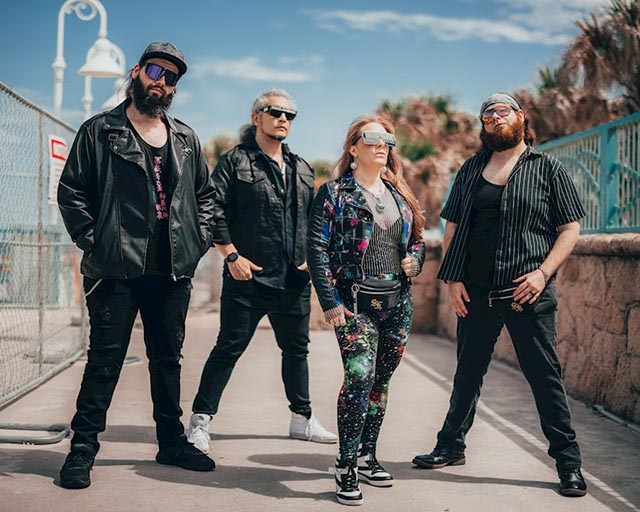
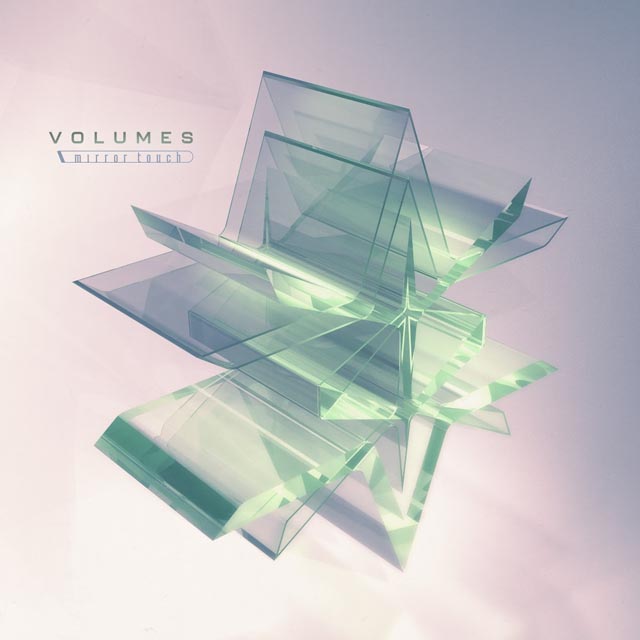
Understanding Volumes requires a working theory of Los Angeles, not the promotional brochure version, but the one locals accidentally describe when they’re stressed. This is the L.A. where rehearsal spaces are wedged between vape shops and dental offices, where the air perpetually smells like overworked amplifiers and whatever everyone had for lunch. It’s the city where half the musicians are convinced they’re redefining heavy music, and the other half are just trying to find street parking before they get towed. Volumes comes from that L.A., the one that produces bands who don’t simply play in linear time but seem determined to bend it into whatever shape their next riff demands. Mirror Touch (out December 12), is the newest entry in that continuum.
Volumes’ history is unintentionally cinematic. The founding members were still teenagers in 2009, too young to know better, too ambitious to care. They came up in the San Fernando Valley, which is one of the few places in America where a kid can grow up listening to Meshuggah, Dr. Dre, and Underoath on the same burned CD and sincerely believe that fusion is a viable philosophy. Their earliest lineup shifts felt less like drama and more like tectonic activity: bassists becoming vocalists, vocalists becoming ghosts, guitarists doubling as de facto therapists.
And historically, they were in the right place at the right time. “Djent” wasn’t yet a punchline or a subculture. It was just a weird Scandinavian suggestion that a handful of American bands heard as a challenge. When Volumes released Via (2011) on Mediaskare Records, it functioned like a transmission from a parallel universe, one where groove and math metal weren’t mutually exclusive. It quietly moved tens of thousands of units, mostly because teens were teaching themselves the entire album on YouTube before they even had driver’s licenses. No Sleep (2014) doubled down, proving that Volumes wasn’t just a scene band; they were becoming the reference point.
Their sound eventually settled into a kind of joyous heresy: music complicated enough to confuse your limbs but still catchy enough to turn a pit into a physics experiment. Hip-hop cadences wormed their way into polyrhythms. Clean vocals intersected with breakdowns built like architectural stress tests. And underpinning it all was the dual-vocalist system, two emotional bandwidths jamming into the same frequency, resulting in a style that felt less like singing and more like an argument with universal implications.
Life on tour both sharpened and unhinged them. They ran with Born of Osiris, Counterparts, DGD, Ice Nine Kills, bands whose fans treat odd time signatures the way sports fans treat statistics. They endured the requisite crises: lineup shuffles, interpersonal combustion, ill-timed adulthood. Guitarist Diego Farias became a central creative axis until his tragic passing in 2020, an event that cracked the band’s trajectory in half. The fact that Volumes kept going afterward isn’t resilience, it’s something stranger, a refusal to accept the plotline they were handed.
Different Animals (2017) and Happier? (2021) found them rebuilding their own architecture in real time. And now Mirror Touch extends that reconstruction with unexpected continuity, largely because Michael Barr is back, but not in the nostalgic “return to form” way bands typically deploy. His re-entry feels more like a narrative recursion, a moment where Volumes gets to remix its own history. Barr doesn’t sound like he’s re-joining a band; he sounds like he’s reactivating an old organ system the body had forgotten it needed.
Fifteen years in, Volumes operates less like a band and more like a long-term experiment in density. They’re still figuring out how much emotional voltage a riff can handle before something melts. Their discography functions like a conversation with themselves, past versions arguing with future iterations about what heaviness even means anymore. They’ve fractured, reassembled, grieved, reinvented, and somehow escalated. And the strange miracle is that after all of it, they still sound eerily close to the future they once imagined in a Valley rehearsal room, long before they had any idea how heavy imagining the future would become.
Here are my top three reasons you should absolutely own this album on Vinyl:
Track 4. California: This state that I’ve come to call my second home has been through a treacherous hell that has somewhat left it physically mutilated. This song rejuvenates the fact that spiritual resilience is never lost in war. I love the word play. I love the gospel emphasis in certain areas, and the purity.
Track 8. Dream: I don’t know where they got the positivity but this was the song that sold me on the fact that this whole album gives me the same emotions I had listening to Bloc Party-Silent Alarm for the first time. The poise of their tonology will put you in a whirlwind of lucrative thinking.
Track 5. Adrenaline: Something about this was perfect timing for winter. The way the sunset hits the palm trees and makes you remember that California is a place for people who have been pushed out of America like runt children. If you feel disconnected, this is where you belong.
The new Volumes album, Mirror Touch, arrives digitally on Friday, December 12th via Fearless Records, with a physical release date set for February 27, 2026. Order the digital record here and pre-order the physical copy at this location.