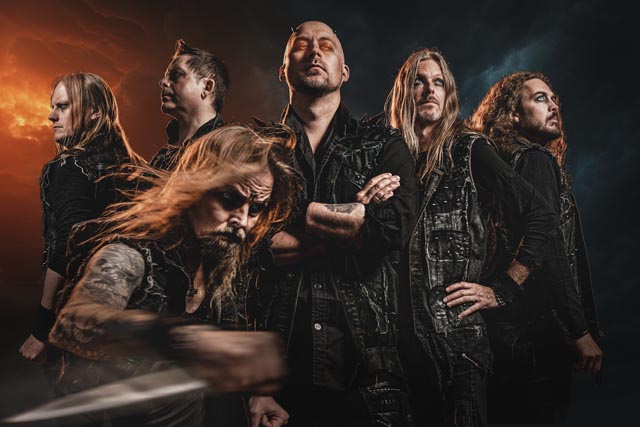
Two decades in, Swedish power metal veterans Bloodbound are ready for their next chapter with album number eleven. Field Of Swords, out today (21st) via Napalm Records, marks the group’s first record with the label. Metal Insider caught up with guitarist Tomas Olsson to talk about the new record, the band’s journey so far, and how power metal itself has evolved along the way.
Audio Interview:
Transcription:
What inspired the concept behind Field of Swords and the decision to step into the Middle Ages?
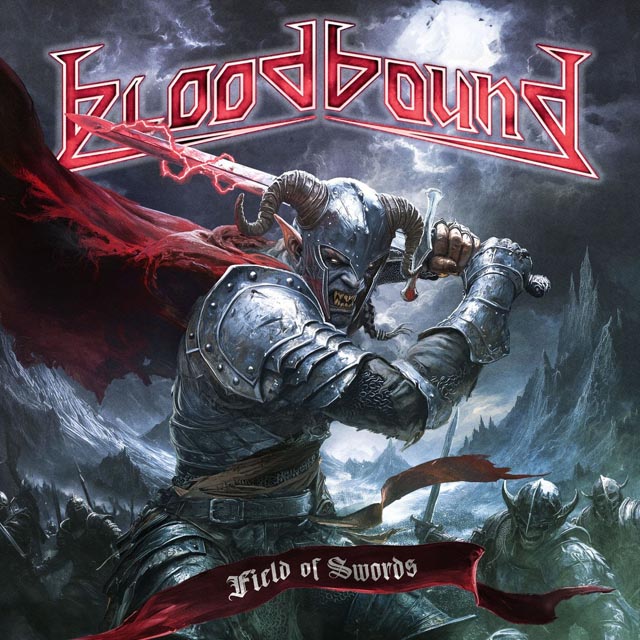
It’s actually like part two of our last album; the previous one was called Tales From the North. It was about the Scandinavian Viking era, from around 900 to 1066. And “1066” is also the name of the last song on that album. So I had the idea of continuing Europe’s historic journey on this new album. So it starts around 1096, during the First Crusade, after the Viking era. The Crusader era was the concept we had in mind when we started writing lyrics and making the songs for the album.
I think it turned out pretty cool because, at the end of the Viking era, was kind of when the first Knights started to appear because of how they made weapons and tools as well, like the skill of forging iron was at its peak at that time. It’s a well-documented time period as well. There are a lot of books and cool movies about it.
I wanted to ask because you put a lot of, like, historical context into the record, and you’re clearly doing your research. What is your process for getting the whole writing and the history, and making sure everything’s more accurate? Or, if it’s through movies, what’s your headspace like to get all that information?
First of all, I’m interested in history, and I’m also interested in what you learn in school. This time period, between 1096 and around 1291, saw nine crusades. And they’ve been shown in different movies, I think, and in books as well. One of my favorite books is actually by a Swedish writer. And that book is about a fictional Knight Templar from Sweden who goes to Jerusalem. The character is made up, but the story is accurate, as if he had witnessed all the events of that time period. And it’s, like, a trilogy.
So, really cool book with a lot of good historical writing. And movies as well, like ‘Kingdom of Heaven,’ especially the director’s cut from, I think, 2005. It’s one of my favorite movies, too. And that’s, “Defenders of Jerusalem” is set around the same period, the siege of Jerusalem in 1197. So I knew a lot of the historical facts about this era from before, from being a bit of a history nerd. But then, you know, of course, you have to do research as well, but it’s not, I don’t see the album as a history lesson in that way. It’s more like an interpretation of that time period.
We wanted to get parts of what happened into 11 songs, basically. So it’s reflections on it, starting with the Pope declaring a holy war in 1095, 96, gathering Europe to reclaim Jerusalem. And then it started like, because the pilgrims had been going to Jerusalem, and the Byzantine Empire was heavily under attack from the east. So we wanted to make a story about the nine Crusades that occurred during that time. And the song “The Nine Crusades,” which ends the album, is, kind of, a summary of that period.
I love mixing different media into one cohesive album. And, you also have a collaboration with Brittney Slayes for “The Nine Crusades,” actually. How did that come together with getting her involved?
We had actually been thinking about having a guest appearance on one of our earlier albums, but it never really turned out. In the end, we had a few songs that fit, like a duet. And this song, when we were in pre-production and recorded some of it, has a lot of space. And especially in the verse, we felt it could be divided into two voices. And it also needed, like, a storytelling thing, a voice as well. And, Brittney is actually Fredrik, who had some contact with her from before as well. And she’s been a fan of our band, and we really liked them (Unleash The Archers) as well.
And then we met her this summer at a Festival as well, and we played with them. So that was really cool. So we decided to, we were really impressed by her live performance as well. She’s an amazing singer. She’s just as good live as she is on the albums. So we asked her and she gladly accepted. That was really cool. And we started adding the lyrics and melody lines, and she did a great job. And she’s got such a deep, storytelling voice.
You nailed it right there. Like, she’s very good on record and live. So I’m glad that you found a collaboration with her. And, this release actually marks your first with Napalm Records. How has that partnership been so far?
That’s been really good. Our previous label basically released the albums covered by the contract. Then we had some contact with Napalm over the years because they’ve been at festivals. And had shown interest in our band and asked us, you know, when we will be available and stuff. So that’s really exciting. When they gave us a great offer, it gave us a bit of new energy when we were writing the album as well. So it’s been excellent. They seem very good, and we already knew some of the people from the label as well. So that was really nice.
I didn’t see that you guys have any touring plans, like, do you have any plans in the works?
Yeah, it’s in the works. And we’re going on tour in March. Middle of March. March, roughly. We don’t have the dates at 100% yet, but it should be announced any time now. That’s, I’m really excited about that. You know, playing some of the new songs live. And that’s a really great time to go on tour as well, March into April. And it will be centered on Europe, including Germany and its neighbors. So in the spring.
Gotcha. A European tour. And is there a specific song from the record that you’re most excited to perform live, or is it just any one of them?
I’m looking forward to playing “Defenders of Jerusalem” live. It felt like that when we wrote the song, too. Like, it’s a live song. It’s a mid-tempo, catchy song with a singalong chorus. Of course, there will be a few other songs as well, so it’s always nice to have new material on the live set.
I can see you guys and Unleash The Archers on Like 70000 Tons of Metal, doing a surprise guest spot.
Sounds cool. Yeah. Hopefully, we can do it in the near future.
Now, aside from the tour in March, do you have any personal goals for the band for next year?
It would be cool to play—Wacken Open Air in Germany. So we’ll see what I. There’s nothing written yet about that, but we played the Wacken Full Metal Holiday in Mallorca, Spain, just a few weeks ago. And we met some nice people from the Wacken organization. That was a really cool show to play, too. It was on the beach in Mallorca, an island off the coast of Spain. We actually played an acoustic version of “Defenders of Jerusalem” on the beach. That was strange. It was the first time in Bloodbound’s history playing acoustic on the Beach. And then we had the show later that evening. There were a lot of people swimming around in the swimming pools. So yeah, it was very nice. It was cool and warm weather in Sweden, now it’s starting to get really cold. It’s going to get cold and dark in a few weeks. Well, we’re going to have snow and total darkness.
It’s that season. And then hopefully, yes, the summer festival will start again.
Yeah, exactly. And it’s a good time to write new material, focus on some recording, and stuff. In the winter, the only thing you can do here is go skiing or ice fishing.
So you’re already starting to work on the next record?
We have some ideas, write songs all the time, but some material will surely end up on the next album.
This year actually marks about twenty years since Nosferatu was released. Looking back, how has the band evolved the most since then?
It doesn’t feel like twenty years, but when you say it, it feels like a long time. We’ve kept the Bloodbound sound pretty much the same. Over the twenty years we worked together, one of our albums, like Tabula Rasa, released around 2009, was more progressive. But that’s, then we got back again into the more traditional sound. We wanted to polish that traditional European power metal sound and make it a little bit more modern. So that’s what I think—kind of the musical journeys. And we got a good start with the first album, Nosferatu, because, as I remember, we sent out demos to record labels around 2004. We got quite a lot of offers for that demo from record labels. So we got a good start on our first album. We had some lineup difficulties and changes in the first few years, but in 2010 and 2011, Patrick [Selleby] and Anders [Broman], the singer and bass player, joined the band. That was around that time, when we felt like the band was really stable, had a good platform, and had a good songwriting team.
And. Have you learned any, like, specific lessons along the way that shape the new album now that you’re getting everything together?
Yeah, I think so. It’s a lot about discipline, really. That’s one thing that we’re pretty good at. Like, we set up deadlines and schedules. If you’re going to make an album, it’s very easy for you; it takes a long time. So you really need to be focused and disciplined to set goals, like if you want eleven songs on an album, you need to set deadlines for when the lyrics have to be ready and that sort of stuff. So we’ve gotten a lot better at the whole songwriting process. And of course, it comes with experience as well.
Deadlines and structure are always helpful. And, you know, talking twenty years, it’s, Bloodbound may not have changed off the course, as you said, much. And the timeframe may not feel that long, but the power metal scene in general has changed or expanded, or what’s your take on the genre itself in power metal?
It’s a little bit strange that the genre was born. You know, around, in the mid-eighties with, of course, the Keeper of the Seven Keys album by Helloween. And then a lot of bands popped up. So it was a long time ago. Feels like it peaked in the mainstream. This genre has become a classic and lives on the fringes of the mainstream, which is both good and bad. But that’s one of the strong things about the genre as well. That has proven itself, and it’s going to stick around, which is cool. I think.
Is there anything else you want to say or add about the new album for your fans to know?
Yeah, one cool thing is that if you don’t know much about the time period, reading the lyrics gives you hints about important events that happened during the Crusader era. So that can be something for you. You can research a little bit. If a song, some lyrics, or something gets stuck in your head, you can do something about it by backtracking to see where it was, what the idea of the song is, and where it comes from. That could be an interesting thing to do.
Feature Image Photo Credit: Björn Liljegrääs