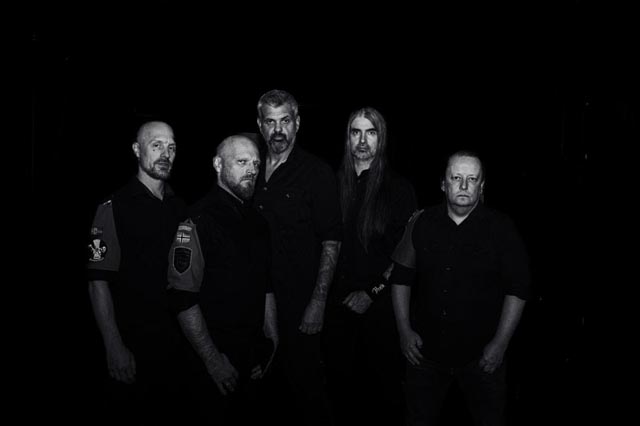
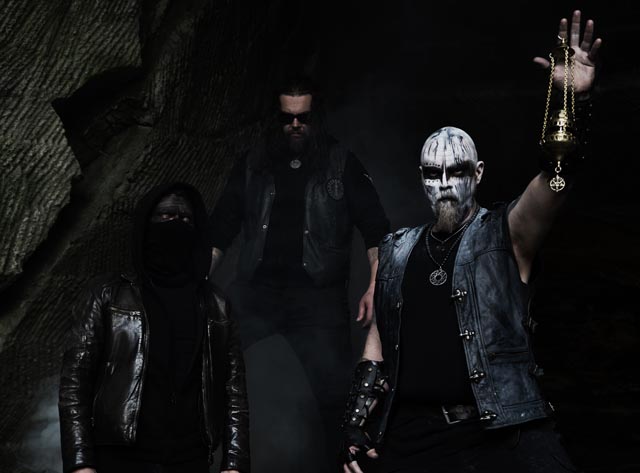
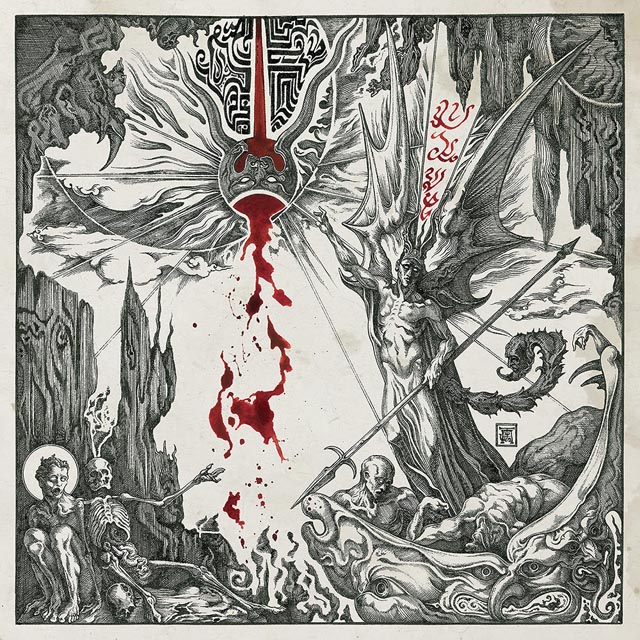
Belgian black metal veterans Enthroned are back with a brand-new chapter as they unveil their twelfth album, Ashspawn, out now via Season of Mist. The follow-up to 2019’s Cold Black Suns captures the group’s occult-driven intensity while marking a powerful return filled with thematic layers to uncover. Frontman Nornagest has teamed up with Metal Insider for an exclusive track-by-track breakdown of Ashspawn, offering a deeper look into their latest offering.
Crawling Temples
“Crawling Temples” opens the path by plunging the listener into the internal threshold where death is no longer an event but a state of being, a living-death suspended in cadaverized rhythms. The song was built around that sensation of metaphysical lucidity that only the shadows can grant, when one becomes foreign to the naive happiness of others and estranged from all meaning. Musically, its dragging pulse mirrors the slow bleed between despair and deliverance, where the body remains but the spirit has already crossed the veil. Within the album’s narrative, it marks the first fracture: the realization that suffering itself is a gate, and that temples can crawl because the sacred no longer stands still. Here begins the over-realm, the realm born after the collapse of the human shell, the first necessary descent before sublimation.
Basilisk Triumphant
This track emerged from the idea of resurrectional arrogance… not the arrogance of man, but the victorious pride of one who has conquered himself. The basilisk stands as the emblem of that internal eclipse, the moment when spiritual tension becomes pleasure and the corpse is allowed to shine with a forgotten light. Musically, its rigid, spine-snapping patterns reflect a being that has turned its own flaws into stone through discipline. In the album’s ascent, it represents the first major ignition: the rising awareness that death, failure, and ego can become sources of power when transmuted through the Sethurian calculus. “Basilisk Triumphant” is thus a hymn to the ego refined, the pride that stands as the proof of resurrection, not as sin.
Stillborn Litany
“Stillborn Litany” was shaped as the ritual of perverse possibility, where death becomes salvation and sadness becomes the instrument of a new joy. It confronts the Western metaphysical dichotomy directly, turning the stillborn child into the seed of a future titan. The repetition of names and syllables creates a psychic blurring, a deliberate collapse of meaning that makes room for a different kind of emergence. Within the album’s tale, this is the moment where innocence is sacrificed and the first true metamorphosis begins, allowing the initiate to step out of the universe of imposed sense and into the universe of possible evil and rebirth. It is the dark womb from which the triumphant self will later rise.
Ashspawn
The title track functions as the album’s central proclamation; the affirmation that resurrection is not static but ever-expanding, much like the pharaohs extending the borders of Egypt in a lineage of dominion. Its creation was driven by a sense of vastness: a sound meant to carry the weight of aeonic birth and the fire of the Bennu bird forging itself at the dawn of creation. Lyrically, it marks the midpoint in the initiate’s ascent, where the Word becomes weaponized flesh and the divine is inverted from within. In the Sethurian framework, “Ashspawn” is the moment of the New Sun, the recognition that self-creation is both the burden and the victory of the practitioner. The new Aeon rises through ash, and the listener is invited to rise with it.
Raviasamin
“Raviasamin” was constructed as a metaphysical disarticulation, a tearing apart of lexicon, syntax, and the very architecture of sense. The music’s serpentine movement reflects the polyphony of signs and the psychic metamorphosis that occurs between Fall and Resurrection, man and his divine becoming. This track represents the moment when the opacity of existence is shed, revealing a subtle alchemy beneath the surface of things. Narratively, it is the turning point where the practitioner returns to himself in an elevated form and embodies the concept of the Edom Belial, having replaced old meaning with a new, self-forged language of power. “Raviasamin” is the breath before transfiguration, the alignment of the fractured self into a coherent and renewed spirit.
Sightless
This song was composed as the collapse before rebirth, the point where vision is lost so that a deeper form of perception can emerge. It channels the agony of spiritual fracture, where the initiate confronts salvation as both wound and weapon. Musically, its shifting planes evoke the sensation of being dragged through inner dimensions, dissolving the last remnants of mortal identity. In the album’s arc, “Sightless” serves as the crucible where transformation ignites internally, burning away the final illusions. It is the moment of surrender through which the practitioner becomes capable of transcending his former self.
Chrysalid
“Chrysalid” embodies the metaphysical metamorphosis itself, the phase where the spiritual body undergoes a surgery of spirit, repairing and consolidating what was broken. The lyrics mirror the literal death of the caterpillar, suspended for years in its cocoon until the divine radiance is strong enough to rupture outward. The song’s composition intentionally oscillates between tension and eruption, mirroring the pressure within the chrysalis before it shatters. Within the album’s narrative, this is the triumphant emergence: darkness wrapped around the sun, a rebirth that carries both the scars and the glory of its making. It is the stage where the practitioner finally rises as a resurgent, Stygian being.
Ashen Advocacy
The closing track was built around the idea of judgment as self-alchemy, the act of naming suffering, examining it to its smallest components, and using it as fuel for transformation. It portrays the practitioner as both accuser and accused, the vengeful judge in his own tribunal, rising beyond complacency or mourning. Musically, its ceremonial weight mirrors the slow, deliberate unfolding of that inner verdict. In the narrative, it marks the final elevation where pain becomes doctrine and the individual becomes capable of forging himself anew through fire. “Ashen Advocacy” closes the album by affirming that sublimation is not grace but justice. The justice one grants to oneself through discipline, endurance, and flame.
Each track manifests a distinct phase of the transformative ascent a discipline forged through Sethurian Satanic praxis and immersed in the currents of the Edom Belial. What may appear as chaos is, from the initiated vantage, a precise and deliberate architecture: an ordered turbulence designed to fracture, refine, and ultimately renew the self. Through this calculated disorder, the practitioner advances toward self-rebirth and the continual evolution of spirit.
Feature Image Photo Credit: Emanuela Giurano